Posts

Showing posts with the label Design

Pondering assigning groupwork...
Image
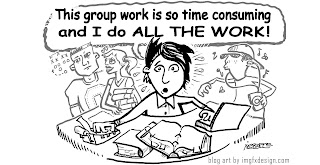
The summer semester is over!  Well, it's been over for several weeks now and the fall semester is in full swing, but I am not teaching this semester (focusing more on projects that have been on the back-burner for a while). Taking a break from teaching actually makes me think more about teaching in an odd way (I guess out of sight, but not out of mind). One of the courses that I teach is an intro course to instructional design and learning technology (INSDSG 601, or just 601).  Since this is a course that introduces students not only to the discipline, but also to the program of study at my university I though that it would be a good idea to give students some foundations in group work since this is something that they will encounter both in the "real" (aka working) world, but also in subsequent courses in the program and they need to be able to work effectively with one another. The way the course assignments work is that there is a big project that last the enti...
Educational Based Research - Part 1

Image
Well, in a week I will be in Edmonton starting off my EdD in distance education at Athabasca University.  I know that most North American doctoral students probably don't think of their dissertation topic this early (I haven't even completed my first course), but I want to be pro-active and work on the thing while taking courses.  So, Rebecca's post on Educational Design Research (EDR) was quite timely.  This isn't my first go around at a dissertation topic, my current topic has evolved over the past couple of years as I was thinking about what I want to do (and which university is best to pursue this). My initial idea was to blend my background in Instructional Design and MOOCs to teach a language, specifically designing a MOOC to teach Greek as a foreign language to novices. This actually came out of making a MOOC out of my MEd capstone .  This was circa 2011-2012 after my experiences with MobiMOOC, LAK11, CCK11 and before the xMOOCs invaded the scene.  ...

Video Games and Learning MOOC - process throughts

Image
Over the past few weeks I've been dabbling with a course on coursera designed by two professors from UW Wisconsin.  I didn't realize who they were (Squire and Steinkueler) initially, but at the "course" progressed I realized that I had read some of their work before when I was reading about video games and learning.  An added benefit was that there were some guest appearances by Jim Gee, someone who is mentioned quite often in the department I work in (Applied Linguistics at UMass Boston) and whose books on video game learning I've enjoyed in the past. Since there really wasn't a lot for me to react to while the MOOC was in session I decided to hold off and do one summative post at the end of the MOOC, which just so happens to be this week. So, the first thing that struck was this insistence that the "M" in MOOC stands for "Massively."  This is just wrong. It's a massive online open course, not a Massive ly  open online course. I ...

LMS, SIS, and empowering the learner

Last week I was reminded of the Canvas Network . Despite the fact that I have a friend and colleague that works for the company there are so many things happening at work that made me forget. In any case, I am glad I stumbled upon the Canvas Network again because it gave me an opportunity to see how another EdTech company, one whose bread-and-butter is the LMS, is approaching MOOCs. Last week I was writing about the innovations that I think are worthwhile exploring further in the Canvas Network, namely letting students know what they are in for if they choose a specific course to take. This got me thinking about campuses today, and admittedly this goes beyond the LMS. Most students have only a small blurb, that is often outdated, to go by when choosing courses for their next semester. Even if you know what a course is about, you don't necessarily know much about the format of the course, the assessment types, whether there are synchronous, asynchronous, or blended components ...

eLearning; mLearning; uLearning; xLearning....

It's been a whirlwind tour in mobimooc this year.  Week 2 is almost done (I count my weeks by a 5-day weekday, rather than 7 days) and only one more week to go! I feel that I have not been as active in MobiMOOC this year as I was in the previous year.  Perhaps it's because MobiMOOC is only half of the duration of last year's MOOC.  It would be interesting to see how often I posted last year (per week) and this year :-) In any case, what has come up this year (that I think wasn't there last year) is a discussion on the nuances of mLearning and what constitutes mLearning, as compared to other types of learning (I call these  x Learning) such as uLearning (ubiquitous), eLearning (electronic), oLearning (online),  iLearning (internet) and so on. Here are some questions and points that were posed to spark discussion on the topic: Does M-learning start when E-learning comes to the end? E-learning doesn't feed our needs thus M-learning were born to fill the gap? ...

MOOCs, and accreditation

It's quite interesting, but the topic of MOOCs and accreditation keeps coming up :-) The post that prompted this blog post came from a post I saw on MobiMOOC today regarding information assessment and recognition of success .  In MobiMOOC 2012 one of the new things that is baked into the course is the awarding of badges , with an eye toward Mozilla's Open Badges. There are currently three types of badges: Wonderful Participant (for signing up in the course) Advanced learner (for participating in at least 2 topics in MobiMOOC) Memorable Collaborator (for being active in 3 topics) and writing a project overview for an mLearning project) I've already achieved #1 by being there, and I think I will most likely get #2.  #3 might be a little more problematic since I don't have much time to think of a new mLearning project, and I don't feel comfortable just picking from my bag of existing mLearning ideas (even though I haven't articulated them before, or implem...

MOOCMOOC (μMOOC) Day 5 Reflections

OK, It's Friday, one more day of  MOOCMOOC, and today's topic is about creating our own MOOCs.  I've written about my own MOOC creation plans (centering around teaching of language).  I had hoped that I would be able to do this as part of a dissertation, but since a potential dissertation is way way way out there in terms of timing, I think I may have to move on this sooner, rather than later.  I wonder if I start collecting data be my dissertation is approved, if I can use it ;-) In any case, here are my responses to the questions at hand  for today. What are MOOCs about? What are appropriate subject matters, theories, ideas that they can explore, explain, or explode?  Initially, for me anyway, MOOCs were a curiosity.  I was out of school, and wanted to learn more. A MOOC was something I could explore beyond the content.  That being said, like my colleague RJH, I've gotten used to the form factor of the MOOC and it's brought me back full c...

It doesn't all start with engagement

I was reading a post on change11 the other day and this video was talked about. The essence of th video is that in education these days we've gone crazy with assessments and we forget about th learner. Fair enough, I believe that this is indeed true in some states and school systems, especially with things like no child left behind. The problem comes in (for me at least) when the people start talking about engagement first, and not learning objectives or something to assess. They actually see the assessment/objective first as wrong, and this is where they lose me. As educators we need to start off with a certain goal in mind, once th goal (end state acquisition and/or behaviors are known) we can then decide how we would check for these behaviors. Yea, I am putting assessment in second because it's important to know how we will be assessing what we want out learners to know. Once we've worked out goals and assessment methodology, we can then move onto content, perhaps not 1...

DS106 - Week 1 - the web domain.

This must be the easiest thing I've ever had to do for a course - absolutely nothing ;-) The preparatory items for this week include getting you own domain, which I have ( http://www.club-admiralty.com ) and getting some web server space. Having had a website for a long time that stuff is done. My website is designed using Rapidweaver. If you are a mac user, and you want something lighter weight than dreamweaver, wish awesome support, check out realmacsoftware  and their Rapidweaver product. Why do I still use blogger?  Well, as a CMS I like it, and if I change web hosting providers I don't need to worry about my content.  RapidWeaver has a nice 3rd party plug-in that harvests your content from your blogger blog and re-displays my blogger content using the theme settings that are available on my site ( click here for an example of this blog redisplayed on my site ).  The one glitch I haven't worked out is this: when using Disqus as my comment system, on my redisp...

Built-in Breaks for MOOCs

I viewed this week's live session yesterday afternoon (I really wish there were an export to MP3 function, I know WIMBA, one of the products going into Blackboard Collaborate allows this...but anyway - this isn't the MOOC facilitator's fault). In any case, I don't have much to say this week about the topic, so I will be catching up with things that other people write. I was brainstorming the other day and posted this on twitter Idea for longer MOOCs like #change11, factor in one "break" or "catch-up" week for every 4 weeks of content and it seems like a few people liked this idea.  If you look at the Change MOOC schedule  you will see that it is a year-long MOOC, formatted around traditional Western university semesters (fall and spring) with a traditional Western Christian 2-week "break" around Christmas and New Year.   It seems like the scheduling design of MOOCs can be examined through the lens of Change. Many people like the dip-...

Where does a MOOC begin life?

Thanks to Rebecca and her " Does a MOOC need a Needs Analysis? " post I was reminded that I needed to subscribe to George Siemens' blog :-)  George has a recent post titled " Who are MOOCs for? Confused Personal Thoughts " in which he admits that previous MOOCs haven't been user needs driven, but rather driven by the facilitators themselves. His description reminded me a little of BarCamps or CoffeeCamps. It also sheds some lights as to why some MOOCs were better than others.  MobiMOOC and CCK were quite good in my mind, but eduMOOC not so much (I am looking forward to the next iteration of eduMOOC though!) Rebecca has some pretty good questions and insights into this, but I wanted to add my own two cents. I am considering creating a MOOC as part of my PhD dissertation research. Now, it should be said that I am not a PhD student yet, and the PhD program I want to attend hasn't lifted off yet (PhD in Applied Linguistics at UMass Boston - starting proba...

Prezi, revisited

I came across this Prezi course introduction to an "Intro to Learning on The Cloud" course. I have to say that from a teaching and learning perspective the course looks pretty compelling! This introduction was interesting as well, however there is a big caveat. I don't know if this was a self-paced presentation, or if it was used in an in-class presentation. As an in-class presentation I can see this Prezi working, however as a voiceless self-paced presentation it's a major fail. About 40 seconds in, having clicked next-next-next the animations in this prezi made me nauseated - the the point that I needed to stop viewing it! I wonder if this was a case of flashy-prezi use, or just a good presentation for the wrong medium teaching & learning in the "Cloud" on Prezi

Barriers to technology accessibility a myth?

I was reading an article recently on the 5 Myths of Mobile Learning . While I somewhat agree with most of what is said, I take issue with the "Accessibility and Cost Myth" This was perhaps one of the stranger myths I encountered, that personal mobile computing devices are inaccessible because of the inherent cost barriers. Looking around me here in India at the amazing rate of adoption of mobile devices (see Mobile Learning in India) and the availability of mobile networks capable of data that now range contiguously across India (see Networks in Rural India), its obvious cost is hardly a factor in the mobile learning equation. Phones today cost far less than they ever did, do far more and are cheaper to use because network usage charges are dropping consistently. These factors contribute to increased technology availability and subsequent adoption. I think that it depends on what the meaning of Mobile is, and even then there are accessibility constraints. Not everyone carrie...

The value of being clear

Image
Recently I was reading an article on Inside Higher Ed titled the dreaded grade appeal . Before I read it I thought to myself "here we go again! more faculty complaining about students appealing their grades!" I was pleasantly surprised to see that the article isn't really about grade appeals, but rather (if you read it clearly), about being clear in your expectation of the students taking your class. I think that this is a great post to read (despite the comments who seem to have missed the point of clarity) because it gives examples of things to do to be clear (and empathetic) and thus prevent conflicts with your students. In all of my years in Higher Education (around 200 or so credits at the time of this writing), I have only tried to appeal a grade once (which the university administration deflected, but anyway, one B isn't bad). Thinking back to that experience the instructor (an adjunct) did almost everything wrong - the opposite of what this article recommen...

The PowerPoint Design Triangle

Image
I saw this over at the PowerPoint ninja a while back and decided that it would be a good resource to post on here for all the PowerPoint n00bs. It's the PowerPoint Design Triangle - similar to any good-ol' project management/competing attention type of paradigm (gah! I used that word again!) Have a look - it's worth at least five minutes of your time :-)