Posts

Showing posts with the label knowledgeManagement

Institutional Memory
Image
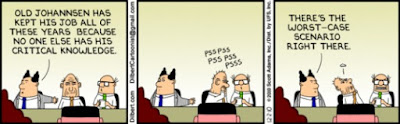
It's been a long time since I've blogged about something educational, other than my classes of course.  With one thing down (and a million more to go), I decided to take a little breather to see what's accumulated on Pocket over these past few months.  I saw a post by Martin Weller on Institutional Memory , and it seemed quite pertinent to my day to day work existence these past six or so months.  Martin points to a BBC article indicating that the optimal time in a specific job is around 3 years. This isn't the first time I've heard this.  About 11 years ago (wow!) I was working for my university library.  I was new to the Systems Department (the IT department in a library) and my supervisor was new.  When we were getting to know more about each other's work histories (before you could look at LinkedIn profiles), she had told me that she aimed to stay there for a few years and then move on. People should only stay in their current work for 3 years...

Siri, Alexa, Cortana...OK google - show me something to learn!

Image
Alright, so here it is, week 6 of NRC01PL. Even though I am technically  in the same week as everyone I guess I am still marching to the beat of my own drummer.  I wanted to join the live session on Tuesday, but other things intervened.  Oh well. The topic of this week is the personal learning assistant.  Hence my little callout to the four major virtual assistants (Siri for Apple, Alexa for Amazon, Cortana for Windows, and Google...for Google). I actually did try asking Cortana to "show me something to learn" but  I guess the bing search engine didn't know what the heck to do with my query. Google wasn't that much help either.  We haven't reached the point yet where they know enough about me in order to recommend something.  It's a little odd given how much data google probably "knows" about me. So, what is a Personal Learning Assistant (not to be confused with Personal Assistant for Learning)?  According to Stephen the PLA is a platfo...

EDDE 806 - Post V - The final one of the spring 2016 season

Image
A couple of weeks after the last session of 806 for this spring aired  I had an opportunity to observe the proceedings from across time and space (aren't recordings grand?).  Looking at the (small) crowd that attended the live session maybe I should have attended!  Anyway! It does should like next fall, or perhaps next spring once I am formally in 806, there might be a ton of people attending, so the check-ins might only be for people who are done with 805.  I like the check-ins as it provides me with a sense of what others are going through (the whole "suffering together" bit), but I also don't want an 806 session that goes on for 2 hours (or more).  I would almost prefer to have more sessions but  have them seriously capped at 90 minutes rather than have marathon sessions.  Something for pedagogical planning I guess :-)  I plan on attending 806 sessions (at least some of them) while I am in 805, so we'll see how that goes. In any case, this s...

Quick thoughts on IEML week

I don't follow the main presenters much on Change11 any more, partly because of the gaps in the schedule, and partly because some things seem like repetitions of previous topics...and partly because I started a new job and have little time.  I do however follow the daily newsletter and when I see posts from people that I've interacted with in the past, like Jenny, Jupidu, Jaap and Serena I put them on my reading list.  This week Jupidu's and Serena's posts piqued my interest in IEML. Initially I didn't really want to deal with a semantic meta language for the web.  I've been hearing about the "semantic web" for quite some time now, and (honestly) I am getting a bit fatigued by it. Having read the quick overviews I decided to go in and read the chapters provided by Pierre Levy. I have to say that it is quite interesting.  Semantics isn't really my thing - don't get me wrong, I would like to like semantics (I find the study of semantics fascinat...

Online Self-Organizing Social Systems

This morning while commuting to work I had the opportunity to the last of this week's reading from David Wiley and Erin Edwards (Change MOOC) on Online Self-Organizing Social Systems . I have to say that this really piqued my interested. While reading the document I was transported back to my MBA days when I first started learning more about the topic of Knowledge Management and the work of Etienne Wenger . I am a big fan of communities of practice and I have attempted to get an instructional design community of practice going with mixed results (mixed results are just my opinion, other's opinions may vary- more in article form here ). I have realized for a while now that instructional design and knowledge management go hand in hand however I had never bothered to actually put anything to formally bind them.  At times instructional design can seem very rigid, after all it is a systems view of learning, and there is a process to getting things done (also known as "a meth...

Informal Learning in the Workplace

One of the topics that we covered in our Knowledge Management class back in the days of the MBA was this whole concept of informal learning (or water-cooler learning) that happens day-to-day in any given workplace. In those 1 minute interactions at the watering hole you may learn something that impacts your job performance (for better or for worse) and one of the goals of KM was/is to capture such leaky knowledge for the benefit of everyone in the company. I came across this presentation on informal learning a little while back and I thought it interesting. I think that this is something that learning professionals should be exposed to if they are in a degree or certificate program :-) 8 Reasons to Focus on Informal & Social Learning View more presentations from Charles Jennings .

Evolving Paradigms in Knowledge Management

I came across this brief video on the Harvard Business Review the other day on how knowledge management is moving away from the repository as goal . Here's the transcript of the video: One of the interesting ways of capturing the problems with traditional knowledge management is it came at knowledge from a stocks viewpoint, a stocks of knowledge. The problem is, we have knowledge, it's distributed and dispersed throughout the organization. How do we capture it and make it available to others? Certainly a big challenge, I don't want to diminish that as a value, but I think what people found as they tried to implement the various systems and methodologies to do that is there wasn't really a lot of motivation for people to invest the time and effort to develop and define those stocks and make them available as part of a broader repository. This kind of approach really shifts the attention from stocks of knowledge, what we know today, to defining and developing new k...

More collaboration, please.

Image
There was an article that I saw a few weeks ago called Expert Predicts 6 Future Trends in Training . Being a sucker for predictions I went right ahead and I read it. I have to say that the six predictions were quite good - because we are already there, and we have been there for a while now. We covered all of these issues when I took courses in my MBA program about three years ago in topics such as Knowledge Management. I have also experienced all of these points personally by being part of communities of practice such as MacOSX.com , HowardForums.com , and many, many other communities. The big thing here is the how . How does one effectively bring these into the corporation and into academia? How does one attain buy-in to get people to use the systems? There are many more hows here than I care to point a stick at. The main point is that these predictions are not predictions at all, but rather statements of where we're going (given proper leadership of course). The main thin...

Objections to Social Learning

Image
I was reading a blog recently ( click here for source ) where the blogger had a presentation from the Mzinga crew about objections to social learning. I went through the presentation, and it was actually quite interesting, but I had heard it all before :-) The objections to social learning (as much as I cringe when I say social learning ) are the same objections that I examined when I was learning about Knowledge Management and Knowledge Management Systems. I do love both proprietary knowledge management systems, and more open networks like twitter (although for work I would prefer Yammer), facebook and so on. The problem that I have is that people experience an all or nothing type of situation. You are either all against it, or all for it. And if you are all for it (institutionally I mean), you don't make appropriate use of your limited resources. This is an interesting presentation, and if you don't know much about knowledge management...or social learning, have a look. The...