Posts

Showing posts with the label distanceLearning

Preferences for learning modality following COVID19
Image
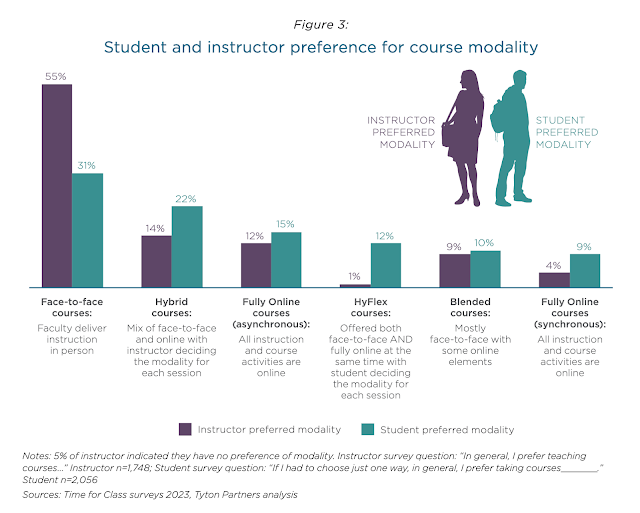
Yesterday evening I came across a post by Tony Bates where he shared some findings from some recent reports on faculty (and student) preferences for learning in a post-pandemic world . I haven't read the reports yet, but I had some initial thoughts based on Tony's high-level overview of those three reports.   Two big things jumped out at me. The first is that students and faculty aren't on the same page (for the most part), and faculty still overwhelmingly prefer on-campus.  Tony notes that, at least in the EDUCASE case, compared to pre-covid numbers, more faculty have expressed an interest in something other than purely face-to-face (about 79% pre-covid, with 50% now). Tyton Partner's Analysis of Modality Preferences The first thing I noticed above is where students and faculty fall in their respective preferences.  If taken together, something other than purely face-to-face is a clear winner for student preferences.  Now, what that something else actually is....

Synchronous, online learning, and "remote" learning

The question of synchronous sessions in online learning has been swirling in my head over the past few weeks.  So has the term "remote" instruction (🙄).  I usually tend to sit on the sidelines these days, maybe throwing a few potshots on twitter here and there when I have time, but this article on IHE today was one where my eyes rolled too hard, and there was an audible grunt in the room... First of all, I guess I should explain my aversion to the term "remote" instruction.  Our field, distance education, has many terms to describe learning at a distance that actually mean something, and have actually had decades of research behind them!  Because the existing terms mean something, and usually have legalistic implications, it's like administrators are using a synonym for "distance" in order to avoid any sorts of contractual agreements that they have made.  For instance, at my institution, if a faculty member develops an online course from scratc...

Formal education and social capital

You don't go to Harvard for the Education. You go to Harvard for the Connections! - someone from my past (I don't remember who). The other day a long-distance friend and colleague posted an interesting blog post pondering (or positing?) that Social and Cultural capital are the main problem in online education . A very engaging twitter thread and discussion ensued (which I am having trouble locating at the moment), but I thought I'd let the dust settle a bit and collect my thoughts on the matter first.  It is a little self-serving too because I wanted to get back into the habit of writing and this seemed like a good opportunity.  As I was thinking about where to start untangling this thread the quote at the beginning of this post came to mind†. As I was thinking about this I interrogated some of my educational experiences, both undergraduate, and graduate, and free-range learning (like MOOCs).  Most of my education was residential in nature. Although I do prefer ...

Campus deadzones, and creepy hallways: where did everyone go?

Image
Found image on Google (not actually a photo of me) Happy Friday dear readers! (umm...anyone still there?  I swear! I am alive! 😆) I've been attempting to write a blog post all week (and trying to do the 10 minutes of writing per day), but I've been failing on that account...I guess Fridays are a better day as things wind down from the week.  In any case, there is an article from the Chronicle that's been on my mind this week titled "Our Hallways are too quiet". Our department chair sent this to us (everyone in the department) as a thought piece, perhaps something to ponder and discuss in the fall - probably because our department is also like the department that is described in the article. I had a variety of cognitive and emotional processes go off, and get gears grinding while I was reading this.  I actually hadn't noticed that the author was from MIT...who only recently "discovered" online learning (like Columbus discovering the New W...

EDDE 806 - Post VI.III - The one with Sir John Daniel

Image
OK, I am almost 'caught up' with the stuff I missed while I was on vacation (at least as far as 806 goes).  I remember receiving an email from Pearl indicating that Sir John Daniel would be presenting. Too bad the internet wasn't that reliable :-/  Oh well, thank goodness for recordings ;-) Sir John Daniel seemed like a pretty interesting  person, and very knowledgeable (with over 300 publications to his name) and he must be a respectable human being because he wouldn't hold 32 honorary degrees from 17 different countries if people only liked him for his scholarship.  I guess the bar has been set for me (haha! :-) ). The only area where I surpass him is in the amount of MOOCs I've taken vs how many he's taken.  Even as a recording it was great to get to 'meet' such a distance education heavyweight (maybe I can email him and we can go for some coffee and discuss the future of DE next time I am around his neck of the woods in Canada ;-)  ). In any ...

Say hello to SMOC (another pointless acronym ;-) )

Image
A Smock The other day an article came across my radar with the title " Don't Call it a MOOC ." Well, of course, I really had to read it because it kind of sounds like MOOC is an insult, so don't insult a course by calling it a MOOC ;-) As if MOOC isn't a bad enough acronym, UT-Austin somehow found a worse one, SMOC (pronounced "smock").  So, what is this SMOC, other than a poor, and unnecessary acronym? Basically, what it boils down to a SMOC (synchronous massive online course) is nothing more than a live webcast of two rockstar professors in a television studio.  I really fail to see where the innovation is, considering the fact that what you really have here is the digital equivalent of sitting in a 1000-seat auditorium, in a face to face introductory course. Sure, they say they have tutors for "small" groups of students, but, as a commenter on the article points out, that is still around 80 students per assistant.  Even then, it's ...

MOOCs in Higher Education - Must resist feeding trolls...

Happy Labor Day everyone! The other day I was going through my two Learning Solutions Magazine articles to see if there were any comments ( Part 1 and Part 2 here) that I might be able to address.  I think it's great when people engage with the reading material on the web in a constructive way, it helps everyone expand their knowledge a little. That said, the comments weren't that many, and they were from a while back, so I thought I would address them here. Comment 1 I'm not sure how you can say that "MOOCs first appeared in 2008." Remove the word "online" from MOOC and you have International Correspondence Schools. Response I think the underlying current of this comment is "everything old is new again." Now, don't get me wrong, I don't think anyone is claiming that MOOCs are this whole new genesis that came from nothing and is here to change the world like nobody's business. However, one can't dismiss that this c...

Blended Learning, and Distance considerations

This morning, while commuting to work, I was catching up on some blog posts from fellow #blendkit2012 participants and I came across a blog post titled Is blended the same as half-distance ? but Andres Norberg. I was originally just going to comment on the blog post itself, but the response was getting quite lengthy, so I converted into a blog post. Anders asks: If traditional face-to-face education is combined with distance education, what happens? Savings of classroom space and lecturing time? Better enrollment on campus due to increased flexibility in scheduling for students? Extra learning efficiency by using modern tools? More stimulating classes? A sense of being modern and up-to-date by enriching a classroom culture with digital tools? All of the above? It's interesting, to consider f2f education combining with distance education, but, when it comes down to it, what does that combination really mean?  For example, our campus has a lot of  web-enhanced courses , ...