Posts

Showing posts with the label Analytics

A way to visualize MOOC students...

Image
Even though this semester is relatively calm, compared to last semester, I still find myself not writing as much as I think I would like.  I've set aside, temporarily, the book I was meant to have finished reviewing last October, on MOOCs, until the semester ends and I can focus on them a little more. One reason for the refocus of energies is EDDE 804. We are focusing on leadership in education, and I am finding myself spending a lot more time pondering the topic.  I was going to be "ruthlessly pragmatic" and just focus on the assessments, but the cohort members provide for some really interesting discussion and points to ponder.  Another thought that crossed my mind was this: am I over MOOCs?  There was a time when I used to check out coursera, edx, futurelearn, and the other not-so-usual suspects for new courses, however these days going to those sites seems more like a chore than anything else.  I've downloaded a whole bunch of videos from previous courses...

Rhizomatic Discussions!

Worlds have officially collided (either that, or the Rhizome has invaded my mind) ;-) This week is the beginning of Humanizing Online Instruction (or #humanMOOC) on the Canvas Network.  As is usually the case, I tend to lurk in more MOOCs than I can actually "complete†"in any given period.  Given my homework for EDDE 802, and my teaching work on INSDSG 684 (and let's not forget the day-job), I wasn't really going to follow #HumanMOOC that closely.  I still don't know how closely I am going to follow along - but heck, I'll give it the old college try. Even though I am not sure what my activity will look like, I thought it would be a good idea to introduce myself in case blogposts or tweets with #HumanMOOC started coming up with my name on them. One of the things that my brief interaction in the #HumanMOOC Forums reminded me of is the potentially Rhizomatic nature of knowledge and participation online.  For instance, I might read something on Maha's bl...

DALMOOC Episode 10: Is that binary for 2? We've reached recursion!

Hey!  We've made it! It's the final blog post about #dalmooc... well... the final blog post with regard to the paced course on Edx anyway :)  Since we're now in vacation territory, I've decided to combine Weeks 9 and 10 of DALMOOC into one week.   These last two weeks have been a little light on the DALMOOC side, at least for me.  Work, and other work-related pursuits, made my experimentation with LightSIDE a little light (no pun intended).  I did go through the videos for these two weeks and I did pick out some interesting things to keep in mind as I move through this field. First, the challenges with this sort of endeavor: First we have data preparation. This part is important since you can't just dump from a database into programs like LightSIDE. Data needs some massaging before we can do anything with it.  I think this was covered in a previous week, but I think it needs to be mentioned again since there is no magic involved, just hard work! T...

DALMOOC Episode 9: the one before 10

Image
Hello to fellow #dalmooc participants, and those who are interested in my own explorations of #dalmooc and learning analytics in general.  It's been a crazy week at work with many things coming down all at the same time such as finishing advising, keeping an eye on student course registrations, and new student matriculations, making sure that our December graduates are ready to take the comprehensive exam...and many, many more things. This past week I really needed a clone of myself to keep up ;-)  As such, I am a week behind on dalmooc (so for those keeping score at home, these are my musings for Week 7). In week 7 we are tackling Text Mining, a combination of my two previous disciplines: computer science and linguistics (yay!). This module brought back some fond memories of corpus linguistics exploration that I had done a while while I was doing my MA in applied linguistics. This is something I want to get back to, at some point - perhaps when I am done with my doctorat...

DALMOOC episode 8: Bureau of pre-learning

Image
I see a lot of WTF behavior from learners. This is bad... or is it? Oh hey!  It's week 6 in DALMOOC and I am actually "on time" this time!  Even if I weren't it's perfectly OK since there are cohorts starting all throughout the duration of the MOOC (or so I suspect), so whoever is reading this: Hello! This week the topic of DALMOOC is looking at behavior detectors (types of prediction models).  Behavior detection is a type of model (or types of models) that we can infer from the data collected in the system, or set of systems, that we discussed in previous weeks (like the LMS for example).  Some of these are behaviors like off-task behavior such as playing candy crush during class or doodling when you're supposed to be solving for x . Other behaviors are gaming the system, disengaged behaviors, careless errors, and WTF behaviors (without thinking fastidiously?  or...work time fun? you decide ;-) ). WTF behavior is working on the system but not the task ...

DALMOOC episode 7: Look into your crystal ball

Image
Whooooa! What is all this? Alright, we're in Week six of DALMOOC, but as usual I am posting a week behind.  In previous weeks I was having a top of fun playing with Gephi and Tableau. Even thought the source material wasn't that meaningful to me I was having fun exploring the potential of these tools for analytics. This week we got our hands on Rapidminer a free(mium) piece of software that provides an environment for machine learning, data mining and predictive analysis.  Sounds pretty cool, doesn't it?  I do have to say that the drag and drop aspect of the application does make it ridiculously easy quickly put together some blocks to analyze a chunk of data. The caveat is that you need to know what the heck you are doing (and obviously I didn't ;-) ).  I was having loads of issues navigating the application, and I somehow managed to not get some windows that I needed in order to input information to, and I couldn't find where to find the functions that I...

DALMOOC episode 6: Armchair Analyst

Image
Week 6 CCK11 blog connections I was trying for a smarter title for this episode of #dalmooc thoughts, but I guess I have to go with Armchair Analyst since I ended up not spending a ton of time with either Gephi or Tableau last week. So, the reflection for week 4 is mostly on theoretical grounds; things I've been thinking about (with regard to learning analytics) and "a ha" moments from the videos posted. I think week 3 and week 4 blend together for me.  For example, in looking at analytics the advice, or recommendation, given is that an exploration of a chunk of data should be question driven rather than data-driven.  Just because you have the data it doesn't necessarily mean that you'll get something out of it.  I agree with this in principle, and many times I think that this is true.  For instance, looking back at one of our previous weeks, we saw the analytics cycle.  We see that questions we want to ask (and hopefully answer) inform what sort of data...

DALMOOC episode5: Fun with Gephi

Image
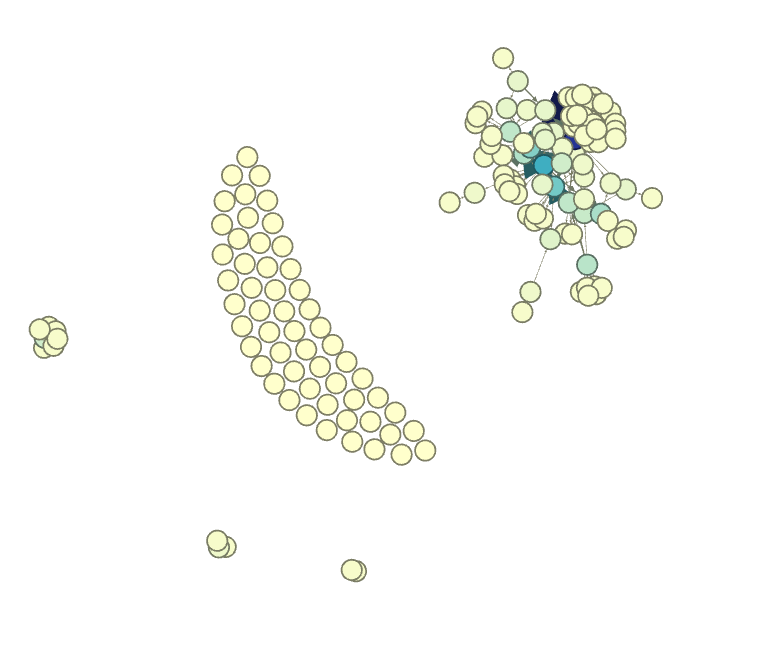
CCK11 Tweet visualization Alright, after a few days of being sidelined with a seasonal cold, I'm back on #dalmooc.  Still catching up, but I have a feeling I am getting closer to being at the same pace as the rest of the MOOC ;-)  In any case, this is a reflection on week 3 where we started messing around with social network analysis (SNA).  This is cool because it's something that I had started doing on another MOOC on coursera, with Gephi, so it was an opportunity to get back on and messing with the tool. So, what is SNA?  SNA is the use of network theory to analyze social networks.  Each person in this network is represented by a node (or edge), and nodes  can be connected to other nodes with a vertex (or many vertices). These connections can indicate a variety of things (depending on what you are examing), however for my usage in educational contexts I am thinking of vertices as indicators of message flow, who sends messages to whom in a network...

DALMOOC, Episode 4: policy, planning, deployment and fun with analytics

Image
Continuing with my exploration of DALMOOC, we've reached the end of Week 2 (only a few days late ;-)  ).  I've been playing with Tableau, which I can describe as Pivot Tables on steroids.  I briefly explored the idea of getting some IPEDS data to mess around with, however that proved to be a bit more challenging than I had anticipated. So, I ended up using the sample data of course evaluations to figure out how to work Tableau.  The following are some interesting visualizations of the data that I had: The one thing I realized, as I was playing around with the data, is that it's really important to really know what your data means.  I thought I knew what the categories meant, because I thought that institutions of higher education used similar lingo.  The more I played with the data, the more I realized that some things weren't what I was expecting them to be.  Thus, in order to know what is being described and portrayed through the visualiza...

DALMOOC episode 3: Screenchomping the analytics cycle description

I've had this app on my iPad, by TechSmith, for the past few years, but I've never really used it.  The App is called ScreenChomp and it allows you to have a digital whiteboard that you can use to write and narrate.  I through that a plain text description of the learning analytics cycle (still catching up on week 2 of DALMOOC) would probably be confusing, and using PowerPoint and Adobe Presenter would be too static.  So, I applied the learning analytics cycle to a course I teach, and I decided to hand-write everything. Heck I attempted to draw as well, but my lack of artistic talent shows ;-) Direct link to the screenchomp (if the embed doesn't work):  http://www.screenchomp.com/t/qE1lplho DALMOOC Week 2, Description of the Data Analytics Cycle from Apostolos K. on Vimeo . How does this cycle apply to your courses?

DALMOOC, episode 2: Of tools and definitions

Image
My Twitter Analytics, 10/2014 Another day, another #dalmooc post :)  Don't worry, I won't spam my blog with DALMOOC posts (even if you want me to), I don't have that much time.  I think over the next few days I'll be posting more than usual in order to catch up a bit.   This post reflects a bit of the week 1 (last week's) course content and prodding questions. I am still exploring ProSolo, so no news there (except that I was surprised that my twitter feed comes into ProSolo.  I hope others don't mind seeing non-DALMOOC posts on my ProSolo profile. Week 1 seemed to be all about on-boarding, of tools and definitions.  So what is learning analytics?  According to the SOLAR definition, "Learning Analytics is the measurement, collection, analysis, and reporting of data about learners and their contexts, for purposes of understanding and optimizing learning and the environments in which it occurs." It's a nice, succint, definition - which I had...

Badge MOOC Challenge 4: Accreditation and Validation Frameworks for a Badge Ecosystem

Image
Value Map Badge It's Saturday, so it must be #OpenBadgesMOOC time :)  The thing that I just noticed about these badges on the #OpenBadgesMOOC is that if you look closely enough they look stitched.  Maybe there is an easter egg hidden somewhere, whereby if you earn all #OpenBadgeMOOC badges they send you a sash with all of them stitched on - LOL :) In any case, it's the end of Week 4 on the MOOC (2 more weeks to go) and this week we are talking about validation.  It's interesting.  One of the things that comes to mind as I progress through these is that the initial "levels" were a little easier to articulate, at least for my #ESLMOOC project, but as the weeks progress it's getting harder since I don't have all of the information. This also draws a parallel to Kirkpatrick's Level's of Evaluation where Levels 1 and 2 are easier to measure, at least in the short term, but Levels 3 and 4 (and if you look at Philip's 5th level ) it gets harder...

Big Data, Evaluations, Adjuncts, Money

Last week was pretty interesting, but between storms, workshops, and work (it's advising and registration time), I only got away with one initial blog post last week.  I did keep up with the discussion, thanks to a large part to the daily newsletter for #cfhe12. As I was reading the various blog posts, this popped up to me: MOOCs and the Teaching Profession . I was really surpsised (I think my jaw dropped) when Rolin's acquaintance told him that he didn't think teaching was a profession.  I guess I shouldn't be surprised. In my area (as I am sure in others), K-12 is highly regulated, so much paperwork and documentation to be completed, I guess anyone pushing paper effectively was be seen as competent whethey they are or not.  K-12, however, is not my area of expertise, I know something here and there.  Higher Education I am more familiar with. I guess, in a higher education context, I am still shocked to hear that teaching is not, by some, considered a profe...

Mass is relative, and the need for numbers that make sense

Image
This week on #cfhe12 I read a couple of posts of interest from my fellow participants (apologies, I am currently on the train with no connectivity, ore lease I would search for those post and link to them :-) ) and there were two key points that I wanted to reiterate, combine, and expand upon. The first point is that mass (well, "massiveness") is relative. I am sure I learned in physics that Mass is indeed relative there, too, but I'd have to take a MOOC to brush up on my high school physics ;-)In any case, 100,000 MOOC participants in course X does not mean that it is equivalent to 100,000 participants in course Y. If you have a course (MOOC) that Iran introductory level course (introduction to German for example), you will most certainly get to sign up (and probably retain) a whole lot more people than a more niche course (let's say "Seminal Works of Bertold Brecht" which is taught and discussed, and written about in German). The introductory course will...

Drinking from the firehose!

Image
Well, the Bonk MOOC (Instructional Ideas and Technology Tools for Online Success) is almost at the end of Week 1.  There certainly is  A LOT of discussion going on, with more than 3000 registered participants; at least that was the number at last count. I honestly would LOVE to see the analytics at the end of the MOOC.  That would certainly be some cool data to crunch (and perhaps write an article about). In any case, both on #bonkopen and in other MOOCs, there has been a sentiment made clear by some participants that they feel like they are drinking from a firehose.  If you are a traditional learner (as in you come from a face to face course environment, or a traditional online course environment) you may feel like there is too much information. Some people want to create smaller cohorts, after all Blackboard Learn supports groups.  I don't mean to be insensitive when I roll my eyes at comments like this; I am sorry if I offend anyone - this is not my inten...