Posts

Are MOOCs just online courses?: it depends!

This post is going to be badly formatted because I have yet to find an Android client for blogger that it as nice as BlogPress on my iPhone. <br> While on vacation, and on a train, I was able to catch up on the news in academia. One thing that came up, among the oodles on MOOC news is the question of whether MOOCs are just online courses (see here: http://www.thegoodmooc.com/2013/06/are-moocs-becoming-just-online-courses.html?m=1 ). <br> It's an interesting question and the answer, at least for me, is: "it depends". One off the big questions is how many people are active in the course, or in other words "how maybe is massive?" The design of a course will differ based on how many people actually participate. You could have a MOOC that resembles a traditional online course, you could have a MOOC that resembles a self-paced course and you could have a MOOC that resembles any one of the many existing field of instruction. <br> The underlying ...

Careers, and the professoriate

Image
While on vacation a friend and colleague sent me a small article warning about the end of the professoriate as a viable career . I was quite curious about it so I had a quick look (after all, it was about MOOCs in part, and I had a little spare time in the middle of the day once museums closed). On the surface it seems like an interesting conversation starter, but for me that's all it is: a conversation starter. I would have loved to hear more of Cary Nelson's speech where the blurb of "If we lose this battle for intellectual property, it's over. Being a professor will no longer be a viable career. It will be a service industry. That's it.” It's hard to speak more cogently about this without hearing the entire context. That said, I do think that this is an interesting point to dissect on its own, assuming of course that there isn't any other information that modifies this statement. Personally I think that the battle for IP has been lost for quite some t...

Of text messages and telegrams

These couple of weeks that have passed I have been on vacation. While on vacation I was able to meet with a colleague that has taught for my applied linguistics department. We didn't plan to talk shop but the discussion did veer toward linguistics. <br> <br> We started talking about text messaging and linguistic research, and of course what can SMS linguistic data tell us about user behavior and communication. Then I had a brainstorm: I'd love to see results of research (or participate in research) that compares text messages with telegrams. They both are meant to be quick, short, and to convey a message. I think this would be a great line of research. I wonder where one could get a corpus of telegram text.

Pre-vacation xMOOC thoughts // assessment and availability

In a few days I will be leaving on vacation, so I won't be MOOCing...or at least I won't be MOOing.  I have downloaded textual materials on my iPad, and I plan on getting a local SIM where I go to keep up with my RSS feeds (until Google Reader decides to kick the bucket).  I thought it would be a good idea to write a few thoughts while I have a hardware keyboard in hand. First up, edX and the Ancient Greek Hero course that I have been following. In a previous post I had mentioned that I had fallen behind with reading of the Iliad Scrolls (the side materials for the course) and I was only keeping up with the main textbook, the Ancient Greek Hero in 24 hours. Week 6 and 7 were actually quite long, compared to previous weeks, in terms of reading, so I have fallen behind on that one too. It is on my iPad, so I will be completing it during my vacation.  That said I did have a lightbulb moment when I was thinking of academic rigor for MOOCs and how xMOOCs are replicating exi...

is MOOC the new "digital native"?

Last weekend one of my friends emailed me one of his Pocket readings in which the link between Second Life and MOOCs was made (i.e. is the MOOC the new Second Life?).   I must admit that I laughed at this because I never found Second Life particularly useful, whereas I do find MOOCs pedagogically intriguing.  The whole disruption aspect is up in the air still for me. I was excited to see, yesterday, on First Monday an article on MOOC Pedagogy .  "YAY!" I thought, let's read something good!  Sadly, the article was a piece of garbage.  This isn't really a knock on the authors, well, maybe a light jab on the arm as opposed to a left hook on the face, but I do see some serious parallels between the whole Digital Natives (and other such classifications) from early 2001 to 2011 and MOOC "research" like this one.  The digital natives sideshow produced many opinion pieces that posed as research; and then these opinion pieces existed in a vast echo-chamber fueled ...

PhD ponderings: Tenure...or not to Tenure

Image
http://harvardpolitics.com/covers/higher-education/tenure-tune-up/ I've been thinking about the concept of tenure these days, and the general concept or career prospects for the next 30 years for me.  I've applied to a PhD program in our College of Management focusing on Organizations and Social Change . One of my old professors, who also gave me a recommendation, asked me what I wanted to do with the PhD.  The interesting thing is that with a PhD, and without a PhD I am content in my current job role in academia.  I think a PhD would give me bragging rights (not that I'd want everyone to call me Doctor so-and-so), but it would also open up some avenues for jobs that are normally not open to those without a PhD, including teaching jobs. It is no secret that there just aren't that many tenure jobs around, and with the adjunctification of higher education, the situation may become worse. Who knows? Maybe I am pessimistic, but I don't see things getting better at...

On the aversion to acronyms

A couple of weeks ago I was online at the Sloan-C conference on Emerging Technologies for Online learning. It seems as though MOOCs were the thing for this conference, and in specific the different varieties of MOOCs.  That said, itseems like many acronyms were floating around both for non-MOOCs, and MOOC-like things such as SPOC, MOLE, BOOC and so on. I've written about the sillyness of acronyms before on this blog, and those following me on twitter probably saw my virtual eye-rolling when I was live-tweeting sessions. Don't get me wrong, I did like acronyms earlier in life, but mostly as a way to play with language. Now, in this environment, acronyms seem like a way to get you noticed, or to get you a paper that others may cite in their papers so you can get some research-cred.  Maybe I am a cynic, but I find that acronyms, in these cases, do obfiscate what's happening or trying to happen. For instance, I've written before about SPOC (small private online course). ...

Language MOOCing

This past week, crazy events in Boston aside, two new MOOCs began: LTMOOC , on Blended Language Teaching, and the Phonetics and Phonology MOOC from the Virtual Linguistics Campus at the University of Marburg.  The Edx course on the Ancient Greek Hero took a hiatus week to allow people to catch up.  I am still sticking to the Ancient Greek Hero course, and I did try to catch up with the scrolls, a secondary reading that's meant to be "fast reading," but apparently I am not fast enough (I seem to be taking my time).  In any case, my strategy for the Edx course is to read the main reading, and participate in the course, and worry about the scrolls later. As far as the language MOOCs go, I decided to stick only with the Phonetics MOOC.  Blended learning is something that I already know about since I am an instructional designer, and given my applied linguistics background I can put 1 + 1 together; so with limited time and resources I opted to just keep an eye out on...

MOOC certification, and a little more on Self-Paced MOOCs...

Last week I got an email from the MOOC guys running the VLC MOOC, and one of the topics was in the email was all about the certification process. In going through this MOOC (really a self-paced eLearning course, but more on that down below), I would like some sort of proof that I went through it (just in case someone asks), but by and large I really don't care for certification for individual courses. What I care about is the knowledge. Here is what I got from the VLC: Class Certification and Class End The class finishes on 31 May. Participants who have shown activity will be sent a certificate. We distinguish the following activities: - ActivityClass 0: no activity --> no certificate  - Activity Class 1: worksheet average < 60% --> confirmation of participation  - Activity Class 2: worksheet average >= 60% --> qualified certificate The certificates will be sent as E-Mail attachments in electronic form ready for printout. By the way, for the fut...

First edX MOOC - Week 4 thoughts

Image
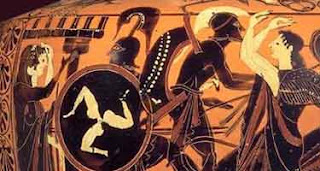
I was looking over edX for a course that I could take out of interest, but also something that I could use to evaluate the pedagogy employed, as well as the platform (LMS) itself. I came across the Ancient Greek Hero, and since I never really did any classics in college, and the last time I read the Iliad was in 7th grade when I was in Greece, I thought that this would be a good chance to kill several birds with one stone: Re-read the Iliad (it's been on my list for a while) Learn a bit more of my own home culture, through a more mature learner lens See the pedagogies employed in this course See how edX works (thus far) Coursewise, I think that there are definitely quite a few nice ideas implemented in this course. First, there is an actual textbook (or at least something that is one volume of collected readings), and it's completely free. Nagy's  The Ancient Greek Hero in 24 hours (H24H for short) is something you can buy on amazon, but it's also availab...