Posts

EDDE 806: Epilogue (of reboots and alternative universes)
Image
I guess this is my "806 is dead, long live 806!" post ;-)  One of the final requirements for EDDE 806 is to: Create a final blog post linking to the 6 earlier posts and providing a final reflection, feedback and any recommendations on the course as a whole. For those who are keeping score at home, other course requirements included the following: Present a 30-45 minute presentation on their proposal or dissertation work and progress and respond to comments and questions. Post reactions and reflections on at least 6 of the presentations (over one or more semesters) using a response template created by the instructor, to their blog in the Athabasca Landing (tagged with EDD 806) Attend and participate in discussion in at least 6 sessions over one or two semesters of the course I am not really sure what a final reflection really looks like for 806, especially considering that I will most likely attend quite a few sessions next fall when the remainder of my co...

EDDE 806 - Post XIII - It's the end of the semester, and I feel fine

Image
Alright folks!  That's a wrap for EDDE 806 for this semester!  The semester went out with a bang with three members of my cohort presenting their dissertation proposal work in progress (and for those on the east coast the session was a little long - after a long day - but well worth it!). The three proposed research projects are  Kim's, titled " Student Satisfaction Levels among Canadian Armed Forces Members toward their distance learning experiences " which deals with Canadian armed forces training and distance education; Rosemarri's , titled " Transforming Learning in Higher Education: Implementing UDL in Higher Education "; and Scott's, titled  " College Leadership and Distance Learning " There were some common themes between these three presentations, and presentations that have been done previously in the semester, be it underlying reasons for the research, methodologies employed, or potential timelines.  Having seen the timel...

EDDE 806 - Post XII - Of Navigators and Succession...

Image
Last evening we had our penultimate EDDE 806 session for this season. On tap for the evening we had Neera's presentation (originally of Cohort 6, but now firmly "one of our own" in cohort 7), and a presentation by Stephanie. One question that came to mind, outside of the context of these presentations, was how long do EdD students stick around in 806 after they have met the requirements of the course?  If they don't come back, why is that?  If they do return, why do they return, and what influences their regularity of participation?  I guess this could be a dissertation topic in and of itself, but it's a question that came to mind as I saw some very familiar names in the guest list on Adobe connect last night, and noticed the absence of other names that I've seen over the last year or so of my 'informal' 806 participation.  Of course, a dissertation topic like this would most likely add 2-3 years to my studies, and that doesn't seem like an a...

Loyalty a one way street?

Image
[Warning: longer than usual post] Recently I came across an article on InsideHigherEd titled In Higher Ed, Loyalty Is a One-Way Street , and the tagline was "Loyalty of students and faculty is often demanded. Is it returned?"   The main thesis of the article is that in higher education the job you're in is the job you're in unless you apply for another job and get in, at which point you can either leave your old job or use your new offer as leverage for a better job (or better pay) at your current job.  The article is written from a faculty perspective, but it resonated with my own experiences at the university.  However, I wouldn't really call it an issue with loyalty , but rather it's an issue of organizational culture and lack of meaningful (to the individual) rewards for that loyalty.   Here are my observations as a staff member from the last (close to) 20 years at my institution, and a story from my first job on-campus. When I first started working...

EDDE 806 - Post XI - Get your Waldorf on...

Image
Statler & Woldorf, muppet critics This past week the presenter of the week was Angie Parkes of Cohort 3, who is a fellow instructional designer!  Angie was presenting to us  her (potential?) dissertation proposal which as to do  with testing the hypothesis that the DACUM process can be done effectively online.  More specifically, her three hypotheses are that (1) an online asynchronous DACUM can produce a comprehensive and rigorous competency analysis; (2) the online asynchronous DACUM can be completed in less than 6 months (2 financial quarters); and (3) the online asynchronous DACUM can be completed for less than $1000. Angie is coming at this problem from a corporate instructional design lens, where a lot of money is spent in corporate environments for training, however 50%-90% of this training is deemed ineffective.  Because of this training departments are one of the first things that get cut when a company needs to tighten the budget (explains...

Are MOOCs really that useful on a resume?

Image
I came across an article on Campus Technology last week titled  7 Tips for Listing MOOCs on Your Résumé , and it was citing a CEO of an employer/employee matchmaking firm.  One piece of advice says to create a new section for MOOCs taken to list them there. This is not all that controversial since I do the same.  Not on my resume, but rather on my extended CV (which I don't share anyone), and it serves more a purpose of self-documentation than anything else. The first part that got me thinking was the piece of advice listed that says "only list MOOCs that you have completed".  Their rationale is as follows: "Listing a MOOC is only an advantage if you've actually completed the course," Mustafa noted. "Only about 10 percent of students complete MOOCs, so your completed courses show your potential employer that you follow through with your commitments. You should also be prepared to talk about what you learned from the MOOC — in an interview — an...

Course beta testing...

Image
This past weekend a story came across my slashdot feed titled  Software Goes Through Beta Testing. Should Online College Courses?  I don't often see educational news on slashdot so it piqued my interest. Slashdot links to an EdSurge article where Coursera courses are described as going through beta testing by volunteers (unpaid labor...) The beta tests cover things such as: ... catching mistakes in quizzes and pointing out befuddling bits of video lectures, which can then be clarified before professors release the course to students. Fair enough, these are things that we tend to catch in developing our own (traditional) online courses as well, and that we fix or update in continuous offering cycles.   The immediate comparison, quite explicitly, in this edsurge article is the comparison of xMOOCs to traditional online courses.  The article mentions rubrics like Quality Matters and SUNY's open access OSCQR ("oscar") rubric for online 'quality'. One S...

Institutional Memory

Image
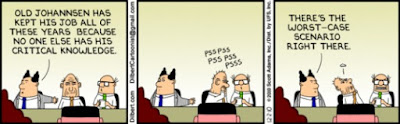
It's been a long time since I've blogged about something educational, other than my classes of course.  With one thing down (and a million more to go), I decided to take a little breather to see what's accumulated on Pocket over these past few months.  I saw a post by Martin Weller on Institutional Memory , and it seemed quite pertinent to my day to day work existence these past six or so months.  Martin points to a BBC article indicating that the optimal time in a specific job is around 3 years. This isn't the first time I've heard this.  About 11 years ago (wow!) I was working for my university library.  I was new to the Systems Department (the IT department in a library) and my supervisor was new.  When we were getting to know more about each other's work histories (before you could look at LinkedIn profiles), she had told me that she aimed to stay there for a few years and then move on. People should only stay in their current work for 3 years...

EDDE 806 - Post X - it marks the spot!

Image
This past Thursday we had our official EDDE 806 session (on Monday, Norine did a mock proposal defense, which I wasn't able to attend, but luckily it's archived for later viewing). In any case, in this session we heard from Renate who reported in on her ideas for a dissertation topic, and there were a ton of interesting things about process that were shared by Susan and others. Renate is looking to do a study in order to understand the lived experience of pre-licensure (nursing?) students, attending their final clinical practicum, after they have been exposed to an IPE (interprofessional education) didactic curriculum. To do this she will use a qualitative, phenomenological, approach to her research design.  Phenomenology seems to be quite popular between the current cohorts (wonder why). She aims to get about 15 participants from a variety of healthcare professions (in Canada) who will be her research participants.  I am looking forward to reading this research when it'...

EDDE 806 - Post IX - About that 'in-process' presentation...

Image
Yesterday evening I presented where I currently am in my dissertation proposal.  I am not sure if Susan was joking or not about 2, 3, 4 years being the 'in process' time to get a dissertation done and defended, but I certainly hope that it's not that long!  I am aiming for May 2019 at the latest for mine. That said, earlier this week I did a few dry runs for the presentation I did last evening, and one of them I recorded.  From a timing perspective it's in the ballpark of what I was aiming for (23 minutes).  I have heard that dissertation proposal defenses and dissertation defenses (the presentation portion) are about 20-30 minutes so I wanted to keep that in mind.  This recorded version is a little rough (it was a try out after all), but it gives you an idea of what my current thoughts are on the matter. What do you think?  I know it's just a window into the mind of this project, but any thoughts would be helpful as I am drafting this beast :) As an...